Bring compute and memory closer. Focus on necessary computation.
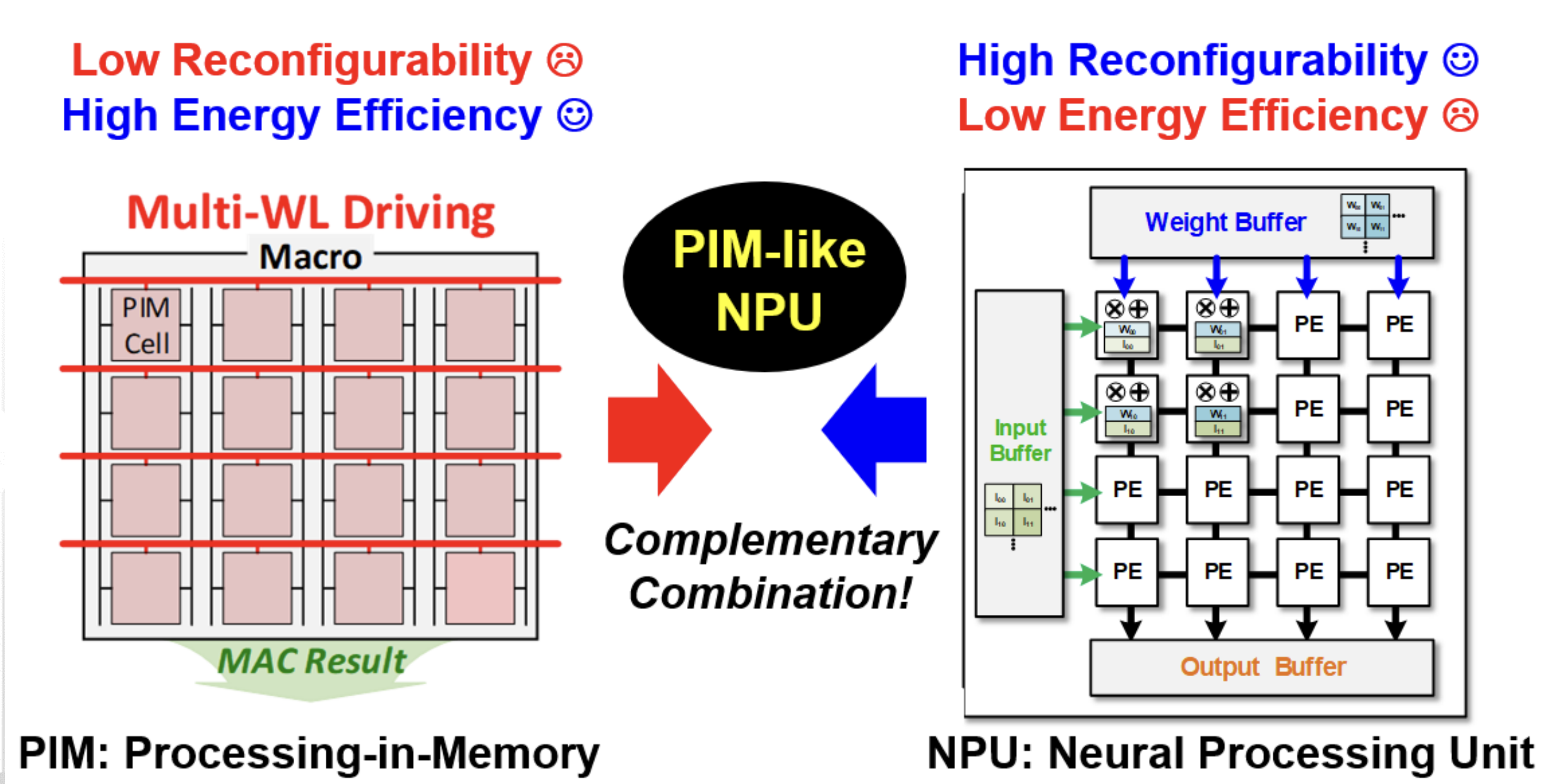
Semunite’s PIM-like NPU places compute units and memory close together to minimize data movement. We have enhanced the NPU IP with Zero-skipping to skip unnecessary computations involving zero values.
Zero-skipping added · Not yet taped out
PIM-like NPU concept combining PIM energy efficiency with NPU reconfigurability
NPU IP configured around the workload
PIM-like NPU IP is Semunite’s core technology. Compute and memory are placed close together, with compute, data movement and memory configured around the model.
Reconfigurable NPU
PE arrays and multiple cores are configured around the workload and compute precision.
Data control
Control data movement and execution within the NPU. CPU and peripheral integration are configured in the chip or system using the IP.
Memory I/F
Configure memory for model inputs, weights and outputs. External memory connections are designed around chip and system requirements.
Domain Accelerators
Compression, speculative decoding and nonlinear function acceleration are planned for SLM and Vision.
A complementary architecture combining the low-power characteristics of PIM (Processing-in-Memory) with the high reconfigurability of an NPU. Rather than relying solely on automated EDA placement and routing, we use manual physical design to place compute units and memory close together. Minimizing data movement reduces energy consumption, computation time and chip area through PPA optimization.
SeM-V1 is the first chip built around this core NPU IP, designed for Voice functionality.
Per-core peak values for the PIM-like array block, excluding I/O SRAM. Synopsys PrimeTime PX on a P&R netlist with gate-level simulation activity, 200 MHz, SS 0.9 V / −40 °C, 100% MAC utilization, no SPEF parasitics.
From model mapping to execution
An example AI SDK flow for applying the NPU IP in SeM-V1. It analyzes TFLite INT8 models and connects NPU and RISC-V execution.
Trained model
Prepare a TFLite INT8 model
Analysis & mapping
Analyze layers and quantization, split NPU/RISC-V work and schedule four cores
C Runtime & Libraries
NPU/DMA drivers, audio pre-processing and host protocol
Build
Build ELF with RISC-V GCC
Flash image
Place ELF and weights in QSPI Flash
Explore the runtime stack
Host application / Host library
The host application and host library exchange command and result packets over UART/I2C.
Audio pre-processing / Inference scheduler
512-point FFT and Q15 log-mel pre-processing connect to scheduling across four NPU cores and RISC-V.
Bare-metal Runtime / Boot ROM
Boot ROM loads ELF from QSPI Flash into a bare-metal runtime with NPU/DMA drivers and flash weight streaming.
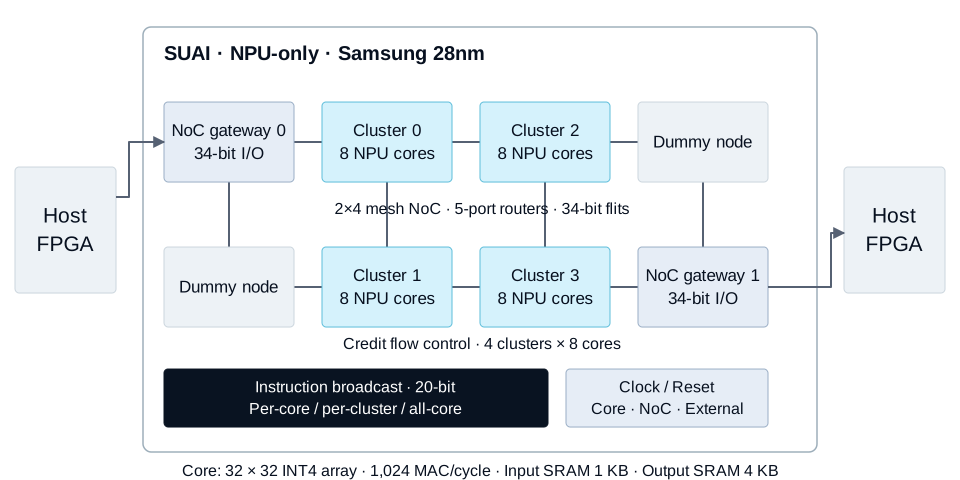
These are future development targets to be refined around the model, quantization, memory and operating conditions. Current NPU validation figures appear separately in the SUAI section.
Discuss NPU IP for your product.
Tell us about your model and product requirements.